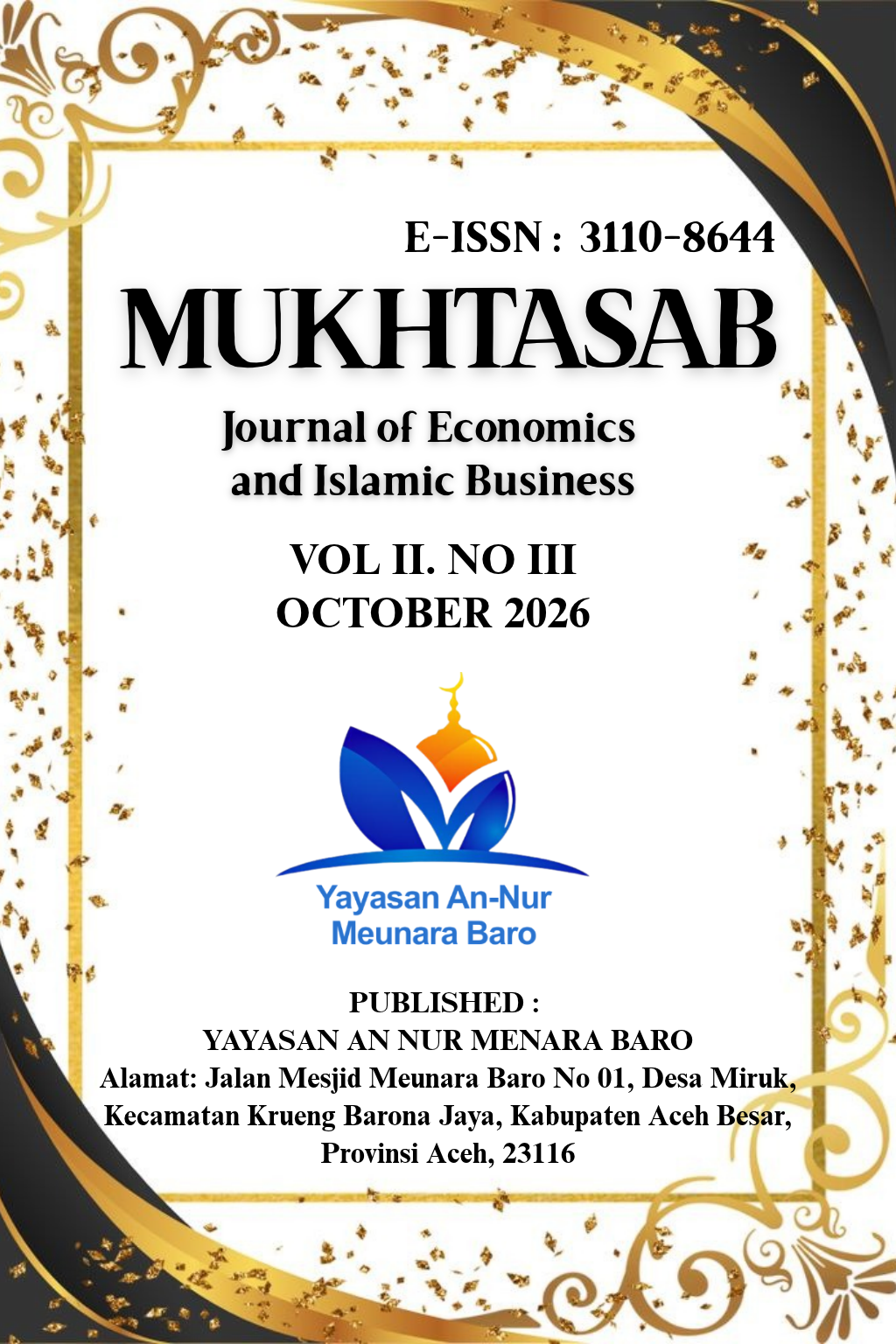
INTEGRATING WAQF AND HALAL SUPPLY CHAIN MANAGEMENT: A NOVEL FRAMEWORK FOR SUSTAINABLE SMES ECOSYSTEM IN EMERGING MARKETS
DOI:
https://doi.org/10.65802/mukhtasab.v2i3.241Keywords:
waqf, halal supply chain management, islamic social financeAbstract
Micro, Small, and Medium Enterprises (SMEs) in emerging markets face persistent operational challenges, including limited access to affordable capital and fragmented supply chain traceability. While the global demand for halal-certified products continues to rise, small-scale producers often struggle to achieve compliance due to high certification costs and weak logistic infrastructure. This study proposes an integrative conceptual framework combining Islamic social finance (Waqf) with modern Halal Supply Chain Management (HSCM) to construct a self-sustaining ecosystem for SMEs. Grounded in Resource-Based View (RBV) and Institutional Theory, the research utilizes a Mixed-Methods Sequential Exploratory design. Phase one conducts semi-structured qualitative interviews with 24 key stakeholders (Islamic scholars, waqf managers, halal certifiers, and SME owners) to identify structural bottlenecks. Phase two employs Partial Least Squares Structural Equation Modeling (PLS-SEM) on survey data from 380 halal SME owners. Findings indicate that productive waqf assets when allocated as physical infrastructure (certified cold chains, shared processing facilities) and revolving liquid capital significantly enhance supply chain integrity and operational resilience. Furthermore, the integration of waqf-backed supply chains exerts a strong positive influence on halal certification compliance and firm performance. Institutional support acts as a crucial moderating variable that amplifies the relationship between waqf utilization and supply chain sustainability. This paper offers practical insights for policymakers, waqf institutions, and SME managers seeking to leverage Islamic social finance for sustainable economic development.
References
Ab Talib, M. S. A., & Abdul Latiff, Z. A. (2015). Issues and challenges in halal food transportation. Journal of Islamic Marketing, 6(2), 266–285. https://doi.org/10.1108/JIMA-03-2014-0028
Ali, M. H., & Suleiman, N. (2018). Sustainable food supply chains: The role of Islamic supply chain management. International Journal of Supply Chain Management, 7(3), 112–121.
Amin, H., & Chowdhury, M. A. M. (2020). Cash waqf for small and medium enterprises: A socio-economic development model. ISRA International Journal of Islamic Finance, 12(2), 273–288. https://doi.org/10.1108/IJIF-07-2019-0105
Barney, J. (1991). Firm resources and sustained competitive advantage. Journal of Management, 17(1), 99–120. https://doi.org/10.1177/014920639101700108
Fornell, C., & Larcker, D. F. (1981). Evaluating structural equation models with unobservable variables and measurement error. Journal of Marketing Research, 18(1), 39–50. https://doi.org/10.1177/002224378101800104
Hair, J. F., Risher, J. J., Sarstedt, M., & Ringle, C. M. (2019). When to use and how to report the results of PLS-SEM. European Business Review, 31(1), 2–24. https://doi.org/10.1108/EBR-11-2018-0203
Hassan, M. K., & Khan, J. M. (2020). Zakat and Waqf as Islamic instruments for poverty alleviation and economic development. Studies in Economics and Finance, 37(1), 135–150. https://doi.org/10.1108/SEF-02-2019-0068
Henseler, J., Ringle, C. M., & Sarstedt, M. (2015). A new criterion for assessing discriminant validity in variance-based structural equation modeling. Journal of the Academy of Marketing Science, 43(1), 115–135. https://doi.org/10.1007/s11747-014-0403-8
Khan, S. A. R., Yu, Z., & Farooq, K. (2020). Green and halal supply chain management: A systematic literature review and future research agenda. International Journal of Logistics Research and Applications, 23(6), 563–581. https://doi.org/10.1080/13675567.2020.1762024
Laeequddin, M., Sahay, B. S., Sahay, V., & Waheed, K. A. (2012). Trust building in supply chain partners relationship. International Journal of Information Systems and Supply Chain Management, 5(2), 23–45. https://doi.org/10.4018/jisscm.2012040102
Mahmed, R., Zulfakar, M. H., & Mohamad, S. A. (2017). Halal supply chain management: A threat or opportunity for Malaysian SMEs? Journal of Applied Sciences, 17(5), 234–241.
Pitchay, A. A., Mohamad, A., & Shaharuddin, S. S. (2018). Priority of waqf features in developing Islamic social finance models for micro-entrepreneurs. International Journal of Social Economics, 45(8), 1205–1221. https://doi.org/10.1108/IJSE-10-2017-0480
Scott, W. R. (2014). Institutions and Organizations: Ideas, Interests, and Identities (4th ed.). SAGE Publications.
Tieman, M., Ghazali, M. C., & van der Vorst, J. G. (2012). Principles in halal supply chain management. Journal of Islamic Marketing, 3(3), 217–243. https://doi.org/10.1108/17590831211259727
Zailani, S., Iranmanesh, M., Aziz, A. A., & Kanapathy, K. (2017). Halal logistics opportunities and challenges in Malaysia. Journal of Islamic Marketing, 8(1), 127–139. https://doi.org/10.1108/JIMA-04-2015-0028
Downloads
Published
How to Cite
Issue
Section
License
Copyright (c) 2026 Siti Nurhaliza, Dian Fanika Sari

This work is licensed under a Creative Commons Attribution-ShareAlike 4.0 International License.